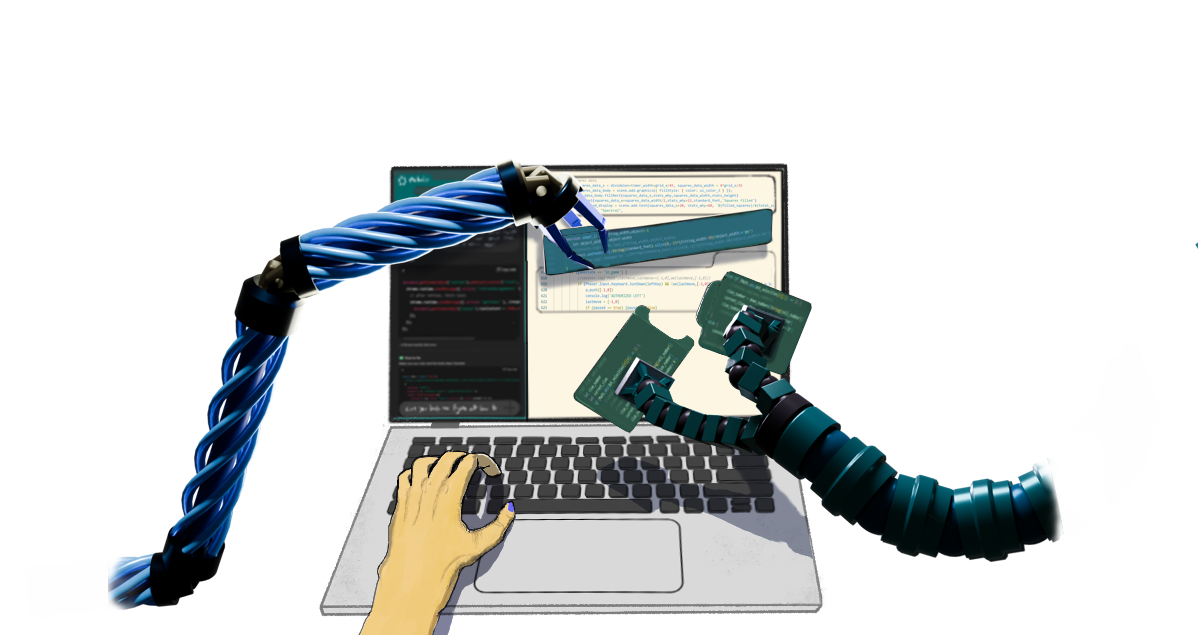
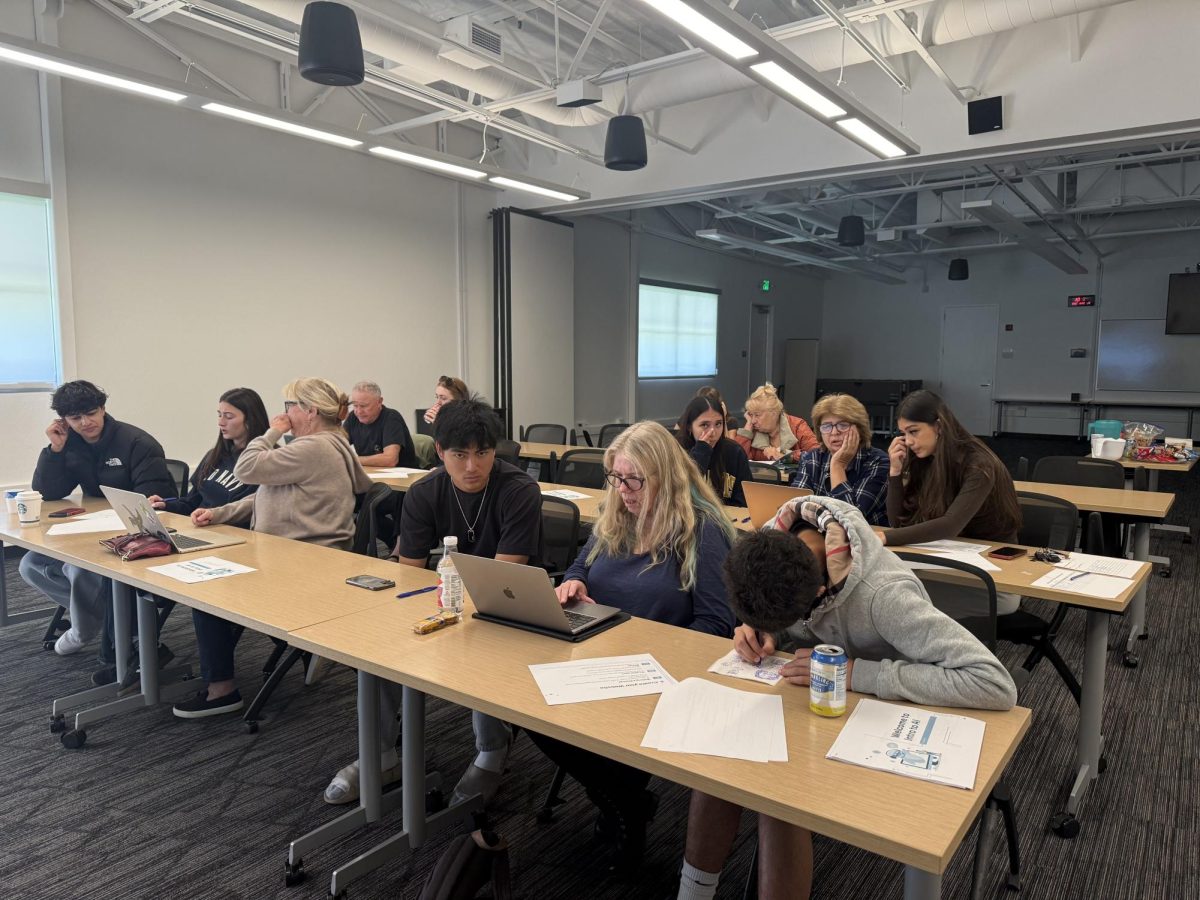
“Vibe coding” — a neologism for using AI to assist with software creation — may have significant and unpredictable effects on the computer science industry.
Anthropic Chief Executive Officer Dario Amodei warns that Artificial Intelligence (AI) could “wipe out” half of all white-collar jobs within the next few years. Whether his prediction is true or not, AI is certainly shaking up the modern computer science industry, especially when it comes to coding.
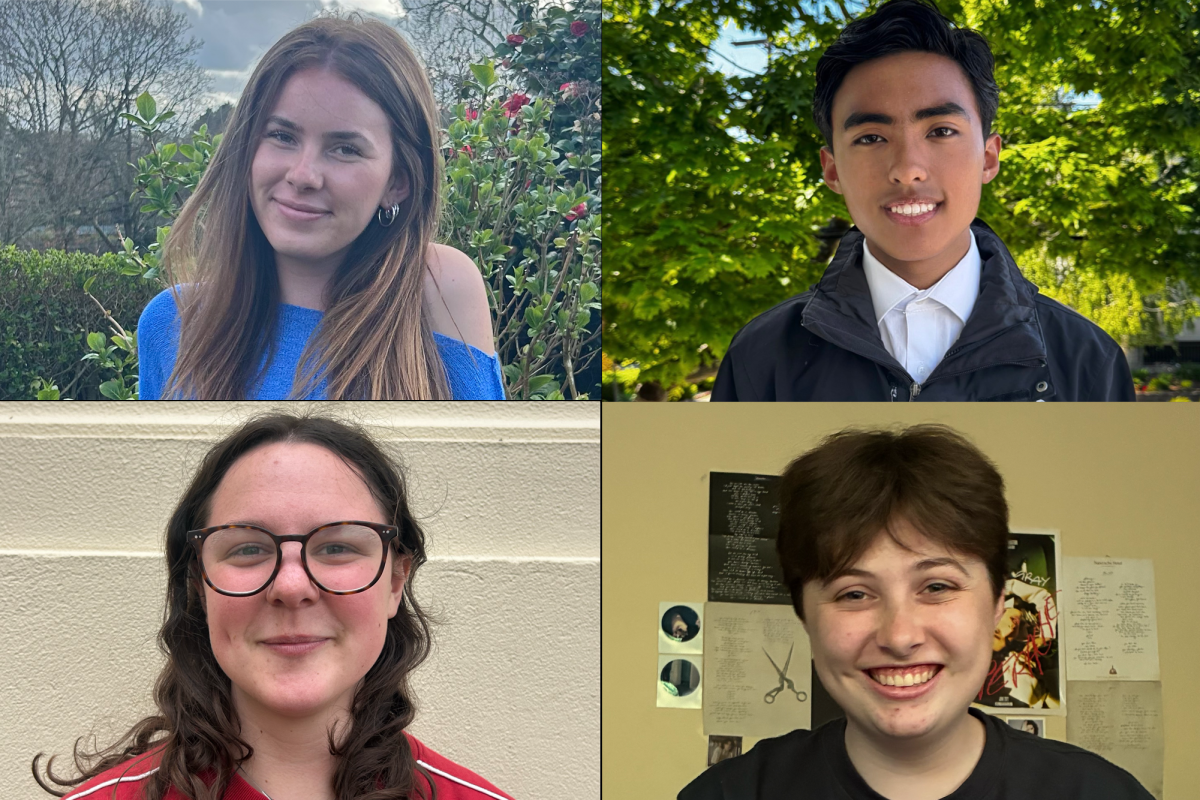
“There’s a difference between coding and programming. Programming is going to stay around for as long as we have computers. It’s the process of debugging, engineering, all of that around creating a system on a computer,” junior Bruce Peters said. “Coding is hitting little keys on your keyboard and making letters appear, and then compiling that, having a program appear. Coding is dead.”
The beginning of “vibe coding”
In February 2025, OpenAI co-founder Andrej Karpathy coined the term “vibe coding.” Vibe coding refers to using AI to assist with software development. It has acquired a negative connotation because people could use AI without programming knowledge, but that is often not the case.
Junior Colin Haine, for instance, started using AI to increase productivity. With AI’s help, he recreated a months-long project in “one day of work.” Granted, because he had already completed the project without AI assistance, Haine already knew a variety of implementation strategies. When working with AI, he first strategizes different approaches to problems, then breaks high-level tasks into smaller parts, and prompts AI accordingly.
Similarly, Peters uses a highly supervised approach to programming, even if models such as Claude’s Sonnet 4.5 or Opus 4.5 do most of the “coding.” He generates a markdown file explaining the goal, detailed context, and a step-by-step implementation plan, complete with self-debugging and checkpoints. While this rarely results in code that works immediately, Peters said effective AI usage can increase his speed fivefold.
Crucially, these techniques rely on an understanding of programming concepts and a feel for AI’s limits. For instance, Peters said AI struggles with problems that involve real-world constraints, such as modeling the physics of a moving robot. Math and computer science teacher Christina Wade agreed, saying effective AI prompts provide specific context that the model would otherwise miss.
“You have to be very intentional with what you’re asking for and very detailed. There’s things that we assume as humans that a computer obviously does not assume,” Wade said. “If we do that in our prompt building, I think the output will be better and closer to what we want from AI.”
Turning tides
A 2025 report led by Google surveyed over 5,000 tech professionals across the industry and found that 90% were using AI as part of their workflow. According to Wade, AI’s efficiency at producing text and implementing simple logic makes it very likely to replace many junior developer positions. That said, Peters is optimistic that AI will create a new niche of job opportunities to adapt to the change.
By the time Burlingame ‘25 alumna Audrey Johnson enrolled in the Massachusetts Institute of Technology (MIT) as a CS student, she was uncertain about pursuing a career in the field, in part because of the uncertainty surrounding AI.
“I feel like in my senior year, it started to become clear that large language models are becoming big in the computer science world, … and senior year is when I kind of started to wonder if this is really what I want to be doing with my future,” Johnson said. “And it seemed very, very uncertain at that time, and it still does.”
As MIT students do not declare a major until sophomore year, Johnson said she was considering switching to electrical engineering. The main reason she cited was that she enjoys working with more physical components alongside software. However, she said uncertainty in the computer science job market was an important consideration — both for her and many of her peers.
“People definitely are uncertain about it,” Johnson said. “I think most people who I’ve talked to who are sort of staying in the software field, are more thinking about, ‘How can I use the technology in my favor, or how can I adapt to it?’”
The world, post-AI
Johnson, Peters, Haine, and Wade were confident that AI is rooted in the industry and will be adapted to over time, both out of competitive necessity and because it offers productivity boosts. They said a silver lining is that the product-creation workflow depends on competent human supervision.
“I do think we will hit a limit, per se, where the AI can write the code, and the AI can turn the human ideas and the human language into computer language,” Johnson said. “But at some point you’re engineering a product, and that requires creativity, that requires problem solving, and I don’t think the AI is going to ever be better than humans at that.”
On Jan. 14, Anysphere, the company behind Cursor AI, posted the results of a week-long experiment in which a group of GPT-5.2 agents was tasked with planning, building, and running a functioning web browser from scratch. In the end, they produced over three million lines of code that, according to CEO Michael Truell, “kind of works,” but is buggy, relies on existing code execution and rendering methods, and lacks visual appeal.
“It’s an LLM. It has training data, it knows what an output is, but as you become higher and higher level, it just becomes less and less accurate,” Peters said.
The need for trained human supervisors and programmers remains evident. According to a study from Visier, the rehire rate among laid-off employees has increased recently, partly because AI agents are still unprofitable in many cases.
“Recently, there’s been like a reverse regression, where programmers are being rehired after they had once been thought to be replaced by AI,” Haine said. “The crazy AI replacing programmers hype is slowly dying off.”
A critical element for the industry is whether AI can handle of higher-level problem-solving. While current AI is far from truly independent, one of Wade’s concerns is that easy access to AI could reduce students’ problem-solving ability — with potential downstream effects.
“That productive struggle, a lot of students have a hard time with that, so the minute they get stuck, they want help,” Wade said. “And so I think we’re enabling a generation of students that don’t have as much grit and persistence as previous generations, because there’s so much more help available so readily that students aren’t having that struggle.”
Still, Wade — along with Peters, Haine, and Johnson — remains optimistic about how the world will respond to AI in the long term, even if the short term seems unstable.
“If we’re so afraid of the bad that we don’t do things to improve the good, then what kind of world is that?” Wade said. “That’s a very pessimistic world, but I think you do have to be careful.”
Your donation will support the student journalists of Burlingame High School - CA. Your contribution will allow us to purchase equipment and cover our annual website hosting costs.
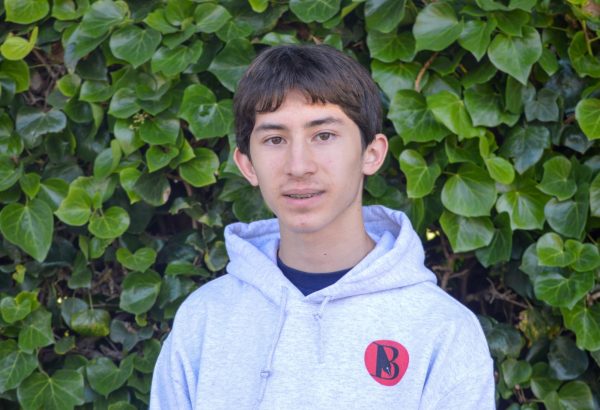
Alex Bertelli is a junior at BHS and third-year journalism student. He’s looking forward to sharpening his skills and continuing to interact with the Burlingame community as a reporter, student, and person. He enjoys various arts such as music creation, robot design, programming, and creative writing, and goes rock climbing when his brother is still around. His favorite words have remained “create” and “entropy,” but it’s not just the words that matter.