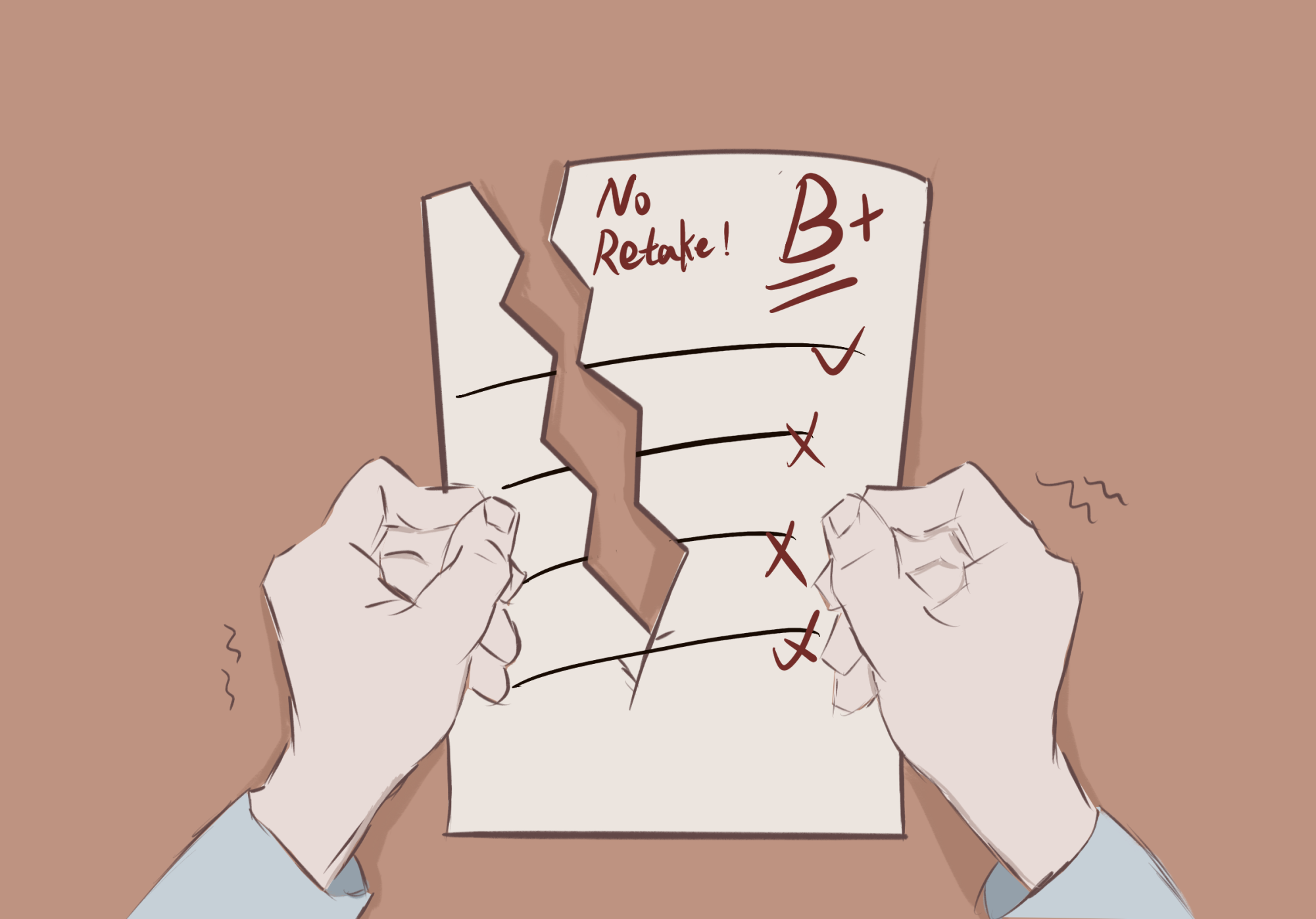

Next year, the Social Science Department will eliminate the option for test corrections and retakes in Advanced Placement (AP) classes. This includes courses such as AP Government and Economics, AP United States History, and AP World History.
Currently, students in Alex Gray’s AP Government and Economics class can retake tests for up to an 80 percent. Meanwhile, in AP United States History, students can earn up to a 70 percent on the first three reading quizzes of the year. Gray said the department is rolling back these policies to reflect college-level standards.
“For these advanced college-level classes, we want to make sure that they have that sort of college-level rigor and that students are not just like, ‘Whatever, it’s okay, I can always retake it,’ which is something that we do see sometimes with students,” Gray said.
Alongside helping students adjust to college coursework, Assistant Principal Aimee Malcom said the new policy will better prepare students for end-of-year AP exams.
“In a college setting, there will not be retakes on tests. And actually follows the district policy around AP exams, where we do not allow retakes on AP exams either,” Malcolm said. “So it’s actually a very clear and distinct preparation for both college and the AP exam.”
Senior Hannah Mandel has had test corrections and retake options in multiple classes and said they motivate students to look back and learn from their mistakes.
“I can understand why they’re doing it, because it is an AP class, and it’s supposed to be challenging, but I think it does take away a little bit from trying to learn from your mistakes, because you don’t have that opportunity to make it up,” Mandel said. “And I think most people just won’t look back at what they got wrong, because they don’t have a reason to.”
Test corrections remain in place in the science department. In AP Chemistry, taught by Joshua Dyl, students can do test corrections twice each semester on either the free-response or multiple-choice section and can earn back up to half their points, capped at 80 percent. For Dyl, test corrections help prevent one bad test day from tanking a student’s grades and give students a chance to learn from their mistakes.
“People are absent, people get concussions, people have all sorts of things happen, which lead to potentially not a great test score,” Dyl said. “So it’s one day out of the semester, you just have a horrible day, or you’re not prepared for whatever reason. I don’t think that should lower you by an entire letter grade for the entire semester.”
Dyl added that while test corrections are helpful, students still have to understand the content to do well in the class.
“It’s not a safety net for everything, but it’s a little safety net that’s still helpful. But I don’t think it’s overwhelming,” Dyl said. “… At the end of the day, if you don’t understand the content for AP Chemistry, our test corrections are not going to save you.”
Principal Jen Fong said one of the reasons the Social Science Department decided to implement the policy was to set clear expectations for the classes next year.
“[The department] wanted to be clear about the expectation of an Advanced Placement course, because a lot of students sign up for the course, but then are expecting to not do college-level work,” Fong said.
For students who are discouraged from taking AP Government and Economics because of the new policy, Gray said they should consider taking the College Preparation (CP) version.
“Students just taking those non-AP classes and then only picking the AP classes that they’re genuinely interested in is going to result in better student welfare,” Gray said. “… That’s going to allow for this new test-taking or no retake policy from being super restrictive or harmful to the students’ craze.”