



























6,000.
That’s around how many black plastic food trays were used in the 2024- 2025 school year at Burlingame, according to an email from Joseph Batchelder, the Executive Chef of Student Nutrition Services at the San Mateo Union High School District. Sophomores Ashlynn Wong and Leia Burlingham had previously received a similar number.
“It’s a very big problem,” Wong said. “We have estimates from the school district that there are about 7,000 black plastic containers used at BHS every school year.”
But the issue with black plastic isn’t simply its abundance, but also its difficulty to recycle. Most black plastics contain carbon black, the pigment that gives them their color. Carbon black absorbs infrared light, a primary indicator that recycling facilities use to sort waste. When black plastics are deposited in recycling bins, infrared scanners cannot detect their composition, so most are sorted as landfill.
“It’s just not a very good disposal method, and it’s something that we should all care about, because it’s something that is actively harming our planet,” Wong said.
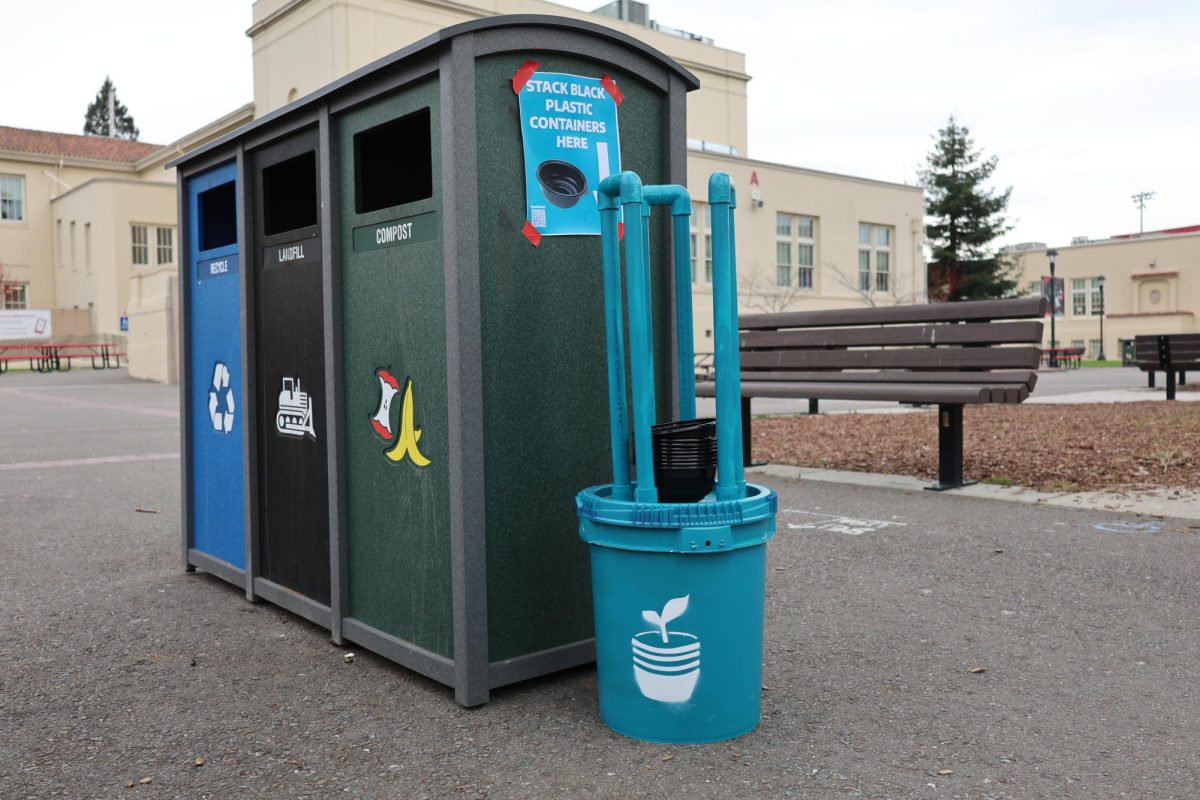
After realizing the extent of the black plastic issue at Burlingame, Wong and Burlingham teamed up to create a solution: Project Stack. Using repurposed buckets from the Burlingame pool, PVC pipes, and spray paint, the two designed “stacks” as collection points for people to drop off used black plastic lunch trays.
“After a lot of prototyping, we realized that we wanted it to, you know, stack,” Wong said. “These containers were designed to be stacked after all, and so these prongs are about one and a half feet tall, and then the bucket is also about one and a half feet tall, so it’s a very comfortable height for people to stack their containers.”
Each day after school, Wong and Burlingham collect the plastic trays stacked in each “stack.” Wong said their long-term goal is to send them to a facility that can recycle black plastic, but currently, they are using the trays as pots for plants they plan to hang up as a “green wall.”
“It’s kind of a contrast to show how this thing that’s killing the environment can be repurposed to have something quite beautiful,” Wong said.
Wong and Burlingham are also collecting data on the number of containers left in each “stack” every day, and plan to present the data to the district to end the use of black plastic containers at Burlingame.
“What we hope to see is eventually no more need for ‘stacks,’ in that there are no black plastic containers to be collected because it would have been out of use at our school,” Wong said.
The project launched on Jan. 12, and as of Jan. 14, Project Stack has already collected around 30 trays every day.
“That is a substantial number, personally, because the original estimated number from the school district was about 40 a day,” Wong said.
Senior and Burlingame Environmental Club (BEC) co-president Kairah Maqsood said she found Project Stack “unconventional” because it focuses on a concrete issue, which she pointed out many sustainable initiatives do not.
“I feel like by focusing on something specific and maybe a bit niche, they can make sure that they actually make an impact of it,” Maqsood said. “Because they don’t have to make these big promises like, ‘Oh, we’re gonna completely abolish waste on campus.’”
Beyond reducing the amount of black plastic that ends up in the landfill, senior and Citizens’ Climate Lobby co-leader Shai Ring said Wong and Burlingham’s initiative has the potential to inspire people to make a difference of their own.
“Seeing other students in your school making a change like this can inspire other leaders as well, because it feels really good to do something meaningful on campus,” Ring said. “And I think people will be inspired by that to make a small change themselves.”
Similarly, science teacher, BEC advisor, and Burlingame School Site Sustainability Facilitator Thomas Bennett said student-run initiatives like Project Stack can bring the most change because students identify and implement solutions on their own.
“To repurpose [black plastic] for art or for something beautiful is so creative and thoughtful and really selfless too,” Bennett said. “We’re not paying these students. We’re not rewarding them. It’s just their own motivation and inspiration to benefit our campus and society. It’s a beautiful thing.”
*Correction: A previous version of this article incorrectly stated there were 7,000 black plastic food trays used in the 2024-2025 school year at Burlingame and that Joseph Batchelder was the Executive Chef of Nutrition Services at San Mateo High School, and has since then been edited. We apologize for the errors.