







































Picture this: You just finished a long, difficult school day. The bell rings, and you walk outside the A building to be greeted by the bustle of Burlingame Avenue.
The loud construction on El Camino Real.
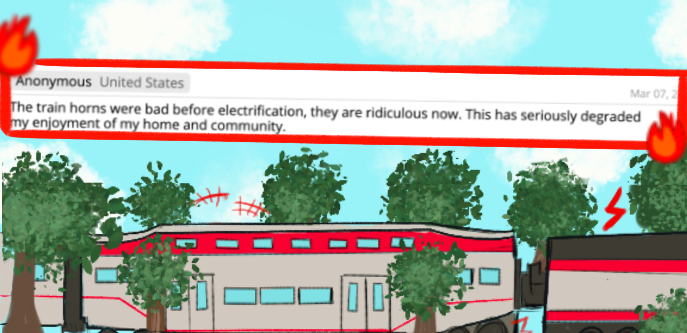
The blaring Caltrain horns.
You realize a sad truth: there is no quiet place you can go to process your day. Noise pollution is a real problem in Burlingame.
Between train horns, plane noise, and traffic on residential streets, Burlingame residents face constant disruption. An online petition titled “Burlingame Quiet Zone — NO TRAIN HORNS AT NIGHT,” started by Robin Whittaker, has 58 charged comments that capture the community’s annoyance — and disturbed REM cycles — due to this problem.
The frustration is understandable, as studies show noise pollution negatively affects mental and physical health. According to the National Institutes of Health (NIH), “chronic low-level noise exposure causes mental stress associated with known cardiovascular complications.” Moreover, psychological disorders such as depression and anxiety are associated with traffic noise exposure (NIH). Students have enough on their plates — noise-induced stress should not be piled on top.
So, how do we fix noise pollution?
The answer is simple: green spaces. According to the NIH, green spaces are “maintained or unmaintained environmental areas, which can include nature reserves, wilderness environments and urban parks.” They are a solution to both noise and stress, as they absorb sound waves and serve as refuges from the bustle of daily life.
According to Forest Research, Great Britain’s government forestry research organization, “trees and shrubs can reduce noise by 5-10 decibels for every 30m width of woodland… this reduces noise to the human ear by approximately 50%.” One More Tree Foundation, a nonprofit focused on greening urban spaces, explains that leaves, branches, and bark break up and scatter sound waves, reducing their intensity. Even better, rustling leaves also produce natural white noise, masking sharp urban sounds.
The benefits of green spaces don’t end there — they also significantly benefit mental health. According to the NIH, “Simple exposure to nature environments is psychologically restorative and has beneficial influences on individuals’ emotions and ability to reflect on life problems.” We all know that for high schoolers, reflecting on life problems is a frequent and necessary activity.
Green spaces provide reduced noise pollution, improved mental health, and a break from busy lives. For a city like Burlingame, where noise is woven into everyday life, investing in green spaces isn’t just for looks — it’s a necessary step towards a healthier community.