

























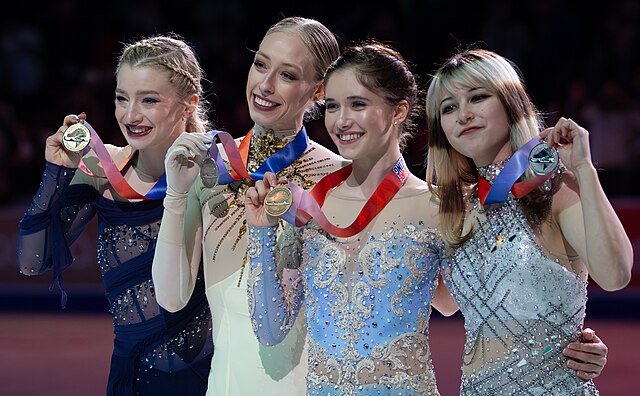
The 2026 Olympic Winter Games in Milano Cortina have been the most gender-balanced Winter Games to date, with women accounting for 47% of the athletes and four new women’s events, including the women’s sprint in ski mountaineering and the women’s dual moguls in freestyle skiing.
“I’m glad that it’s still on the rise and that it’s continuing to increase in numbers. I think it’s really important,” Senior Katie Friedman said. “I think sports is a really important avenue to get closer to equality.”
In addition, all cross-country skiers will race the same distances for the first time in Olympic competition. Previously, men competed in 50km races, while women raced 30km. Now, both men and women will compete in separate 50km mass-start events. For girls’ golf and swimming coach Traci Kreppel, these changes foster a very different environment from when she grew up.
“It’s really cool what they’re allowing women to do now, because in my lifetime, there were just a lot of things that they said that women can’t do,” Kreppel said. “Because it’s too physically demanding for them, which is totally not true.”
According to the International Olympic Committee, the number of female athletes in the Olympics has steadily increased — they accounted for 23% of athletes at Los Angeles in 1984, 44% at London in 2012, and 49% at Paris in 2024.
Girls’ volleyball coach Hannah Korslund said the next step towards gender equality is putting the same effort into promoting women’s sports as men’s sports.
“There’s a lot of attention to some boys sports, and then I think it’s great when we send out messages about girls sporting events that are happening to get big crowds to those too,” Korslund said. “And then nationally, I think similar to that, putting the same effort and time into broadcasting female professional sports as male professional sports would be cool to see.”
Specifically at Burlingame, Korslund said she thinks these changes in the Olympics — the highest stage of competitive sports — will encourage and positively influence female athletes.
Friedman said these breakthroughs send a message to young female athletes, that they’re seen and people are working towards giving them more opportunities.
“It’s sending a message that men are superior isn’t an inevitable thing, and that there is change happening, and there’s not always going to be that vast of a gap between men and women, and we can work to shrink it,” Friedman said.
According to girls’ varsity flag football coach Nicole Carter, progress has been made with gender equality in sports, but it is still in its early stages.
“A lot of times, we’re told you can be whatever you want. And I think now we can actually back that up,” Carter said. “And so I want my female athletes who are watching to be like, ‘If this is what I want to do, if I am that committed, if I put in the work, now I can be there.”