

























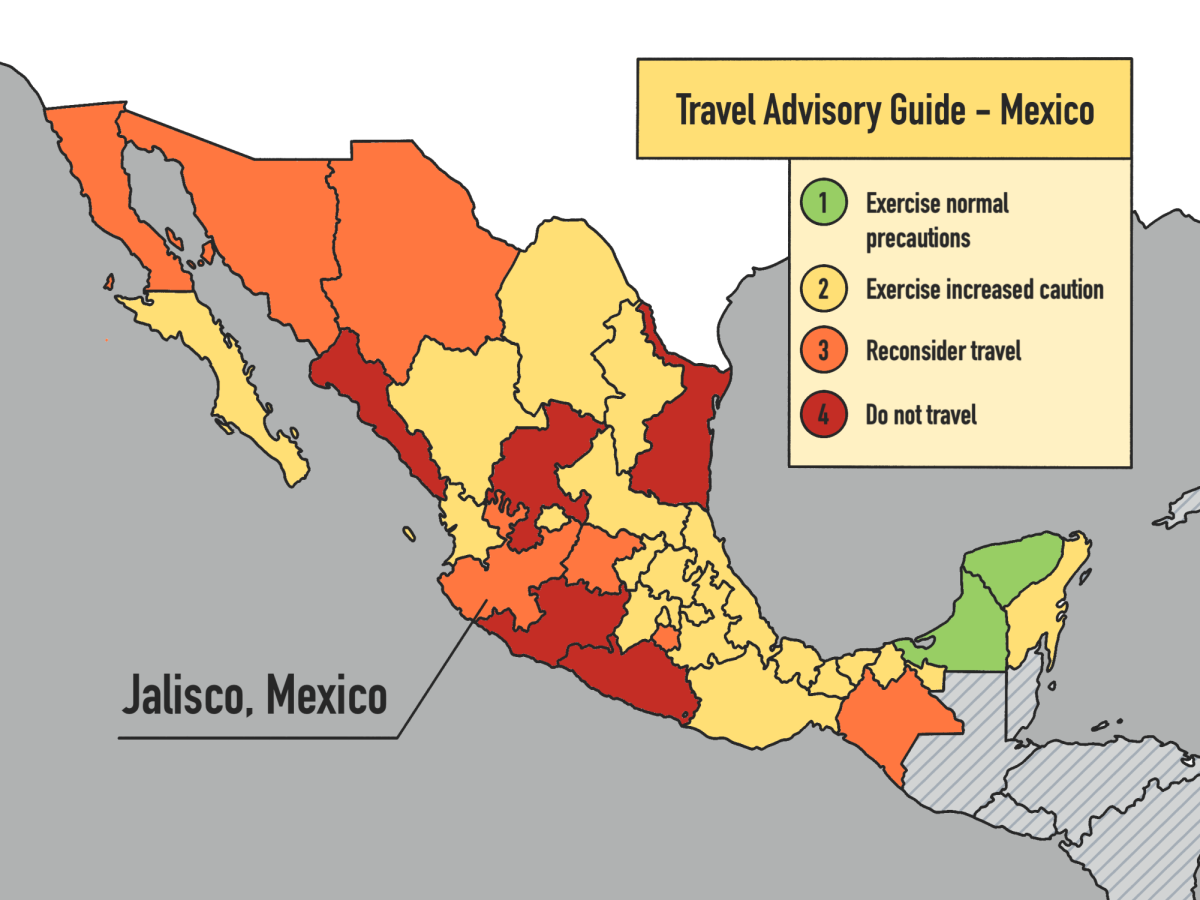
In the days following Sunday, Feb. 22, the Mexican state of Jalisco faced retaliatory violence from the Jalisco New Generation Cartel (CJNG) after the killing of their leader, Nemesio Rubén Oseguera Cervantes, known as “El Mencho.” The cartel set up roadblocks and burned vehicles, leaving tourists stranded in cities, including Puerto Vallarta and Guadalajara, due to airline flight cancellations.
According to the United States Drug Enforcement Administration, the CJNG is one of the largest and most dangerous drug cartels operating in Mexico. Known for permitting local criminal groups to work in exchange for tribute, the CJNG was officially designated as a Foreign Terrorist Organization (FTO) and a Specially Designated Global Terrorist (SDGT) by the Trump administration last year, according to the U.S. Department of the Treasury. Oseguera, who started as a small drug dealer in the Bay Area, expanded the cartel’s influence across the world and engaged in practices such as human smuggling, extortion, and narcotics trafficking, according to the Los Angeles Times.
As the violence spread across Jalisco, travelers and families from the Bay Area felt the repercussions. Senior Olivia Medina recently visited Leon, Guanajuato.
“We went [to Mexico] for a wedding that was planned in advance, and so we didn’t cancel our flight,” Medina said. “So we had heard about everything going on with the cartel before that. A lot of my family members had canceled their flights, and not gone just because they were scared of what could have happened.”
According to Mexico News Daily, hundreds of flights to and from Mexico, specifically Jalisco, were delayed or canceled due to safety concerns and road blockages.
“My family sent an article to our group chat saying that the cartel was blowing up airports, but I don’t think that was true,” Medina said. “I was worried because I feel like once we get there, that might not be a problem, but getting out might be, and flights might be delayed.”
Senior Sophia Yarmolinsky started planning a trip to Mexico with her friends months ago for her birthday. Even then, Yarmolinsky said it was difficult to convince some people that it was safe.
“It was hard to get some of the parents on board, because it is Mexico,” Yarmolinsky said. “There is a little bit more negative connotation when you think of it safety-wise. But we ended up getting everyone’s approval because it isn’t the worst place to go to.”
After hearing about the cartel violence in Mexico, Yarmolinsky said it raised new concerns about the trip’s safety.
“I was kind of shocked, primarily just because it seems that it’s been pretty quiet there, or maybe just the national news doesn’t cover it as much,” Yarmolinsky said. “But it was kind of like the first time I’ve been hearing about such a massive thing go down in the Mexican cartel, having seen that all over U.S. news and all the different news sources that we have.”
Though Medina didn’t witness any violence firsthand, she recognized a notable lack of tourists.
“A lot of locals were out. It was pretty busy,” Medina said. “Tourism was down, obviously. I didn’t see a lot of other [tourists]. There was just us, I felt like we were the only tourists there.”
The U.S. State Department currently still lists Jalisco at a Level 3 (Reconsider travel) travel advisory due to high risks of crime, kidnapping, and cartel-related violence — even as travel schedules returned to normal in late February. Medina said her parents showed less concern than she did throughout the trip.
“My parents felt that everything was safe enough to walk around and do what we would usually do if this [didn’t] happen,” Medina said. “But I was kind of wary about going out, and making sure that we weren’t going out too late at night, and watching the areas that we were in.”
Yarmolinsky said she is still uncertain about the possibility of traveling to Mexico.
“We’re still not sure if we’re going on the trip,” Yarmolinsky said. “I was also supposed to go earlier in June with my family, and that one is most likely canceled. It is Puerto Vallarta that we were supposed to be going to, and that’s where the majority of the issues are. But we have started to reconsider it, especially just because it’s parentless.”