



































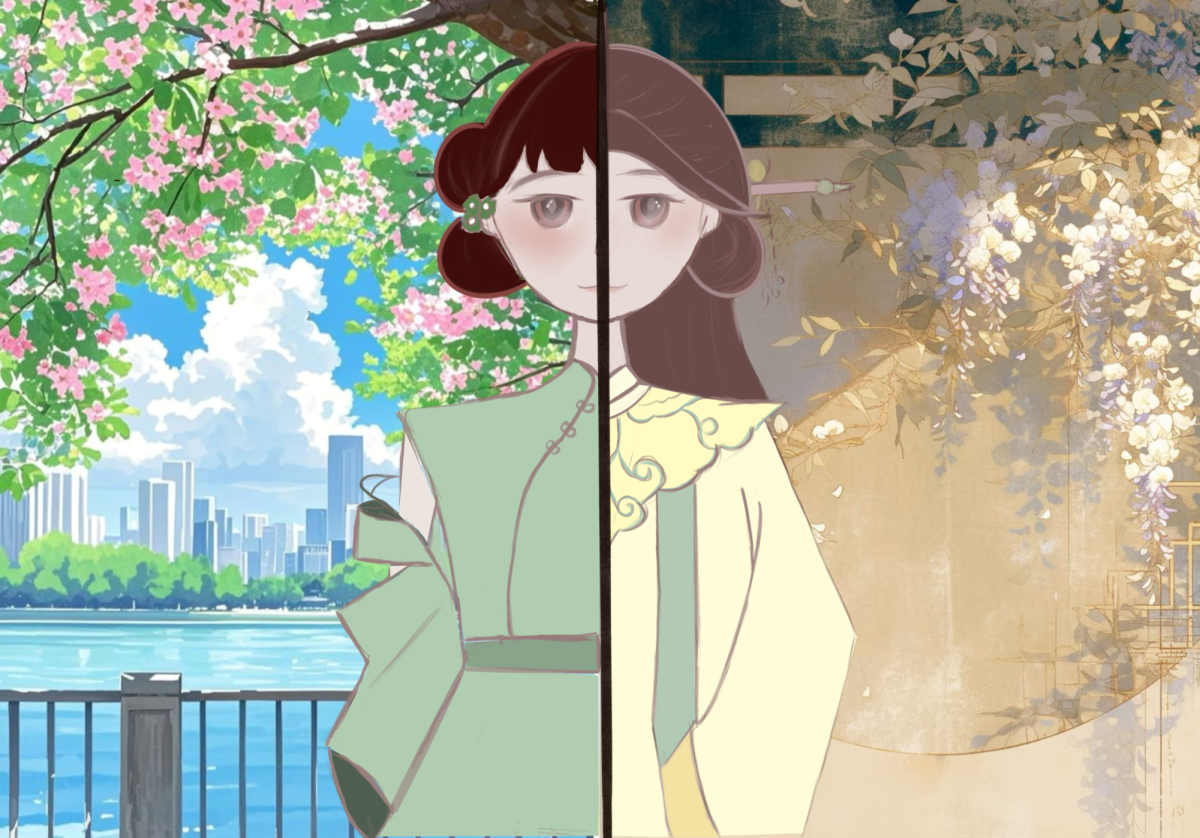
On social media, a type of clothing called “Hanfu” has become increasingly common. For those unfamiliar with its cultural significance, Hanfu might conjure images of pleated skirts, flowing sleeves, or a trending “Ancient Chinese” aesthetic. While it may be fun to follow trends, Hanfu clothing has a 5000-year history and is embedded in Chinese culture. Recently, as the Hanfu “style” has been integrated into modern aesthetics, it has begun to lose its charm, now blending into mainstream fashion.
Hanfu refers to the traditional clothing system of the Han Chinese, with origins dating back thousands of years across multiple dynasties. It is an important carrier of traditional Chinese culture. Today, Hanfu designs are often simplified to be easier to wear and more fashionable, adapting to popular aesthetics and consumer demands.
In some commercial adaptations, traditional garments are reduced to minimal elements such as a single chest panel, stripping away Hanfu’s historical structure. To some extent, it encourages more people to engage with traditional clothing and Chinese traditions, but simplification has been taken too far. Hanfu has gradually been simplified into a few fixed silhouettes and stereotypical styles. The historical context and cultural differences behind these changes are rarely explained, leaving many people with little understanding of the garment’s history.
In reality, there are several styles of Hanfu, each encompassing clothing traditions developed across Chinese history and dynasties. The Han, Tang, Song, and Ming styles, for example, show significant differences in tailoring, structure, and aesthetics. They range from the simplicity of Han-era dress to the openness of Tang silhouettes, the understated refinement of Song clothing, and the more structured, layered forms of Ming garments. These differences reflect the social context and cultural values of each era, making it an important element of traditional Chinese culture.
When these diverse styles are reduced to a single, standardized image of Hanfu, people’s understanding of both the clothing and the culture it represents becomes simplistic and one-dimensional.
Online, Hanfu is frequently marketed through stylized photos and short videos, labeled broadly as “traditional” or “ancient-inspired” without reference to historical period, structure, or cultural context.
Offline, the lack of regard for Hanfu’s cultural significance is also clear. In Beijing, large crowds frequently gather outside historical sites such as the Forbidden City, wearing rented Hanfu for the explicit purpose of taking photos. Many of these outfits are worn briefly and returned the same day, treated as temporary props rather than garments meant to be preserved or understood within a broader cultural context. In this setting, Hanfu functions less as cultural engagement and more as a visual accessory for tourism and online trends.
Still, the simplification and modification of Hanfu have undeniably brought certain benefits. Simplifying the clothing lowers the barrier to wearing it, which increases the number of people who wear it and promotes Chinese culture.
Yet the central issue is not the commercialization of Hanfu itself, but the way commercialized versions increasingly shape how Hanfu is perceived. As companies promote a limited range of modified Hanfu designs, the diverse historical backgrounds of traditional garments are gradually erased.
Even more concerning is the rapid turnover of fast fashion products, which encourages businesses to prioritize speed and visual appeal over historical explanation or cultural context. However, Hanfu is a historical clothing system with a long history, which cannot be understood in a short period of time, and the Chinese culture it represents is consequently obscured. Over time, this leads to the simplification and stereotyping of the culture.
Hanfu is not an isolated case. It’s just an example of a widespread phenomenon: culture enters the market, gains greater visibility, but also risks being redefined. When market logic becomes the primary way of understanding culture, it loses its originality, diversity, and depth. Recognizing this is essential because cultural consumption should not allow the market to dictate how culture is understood.
*This article was previously written in Mandarin and translated into English using Google Translate.